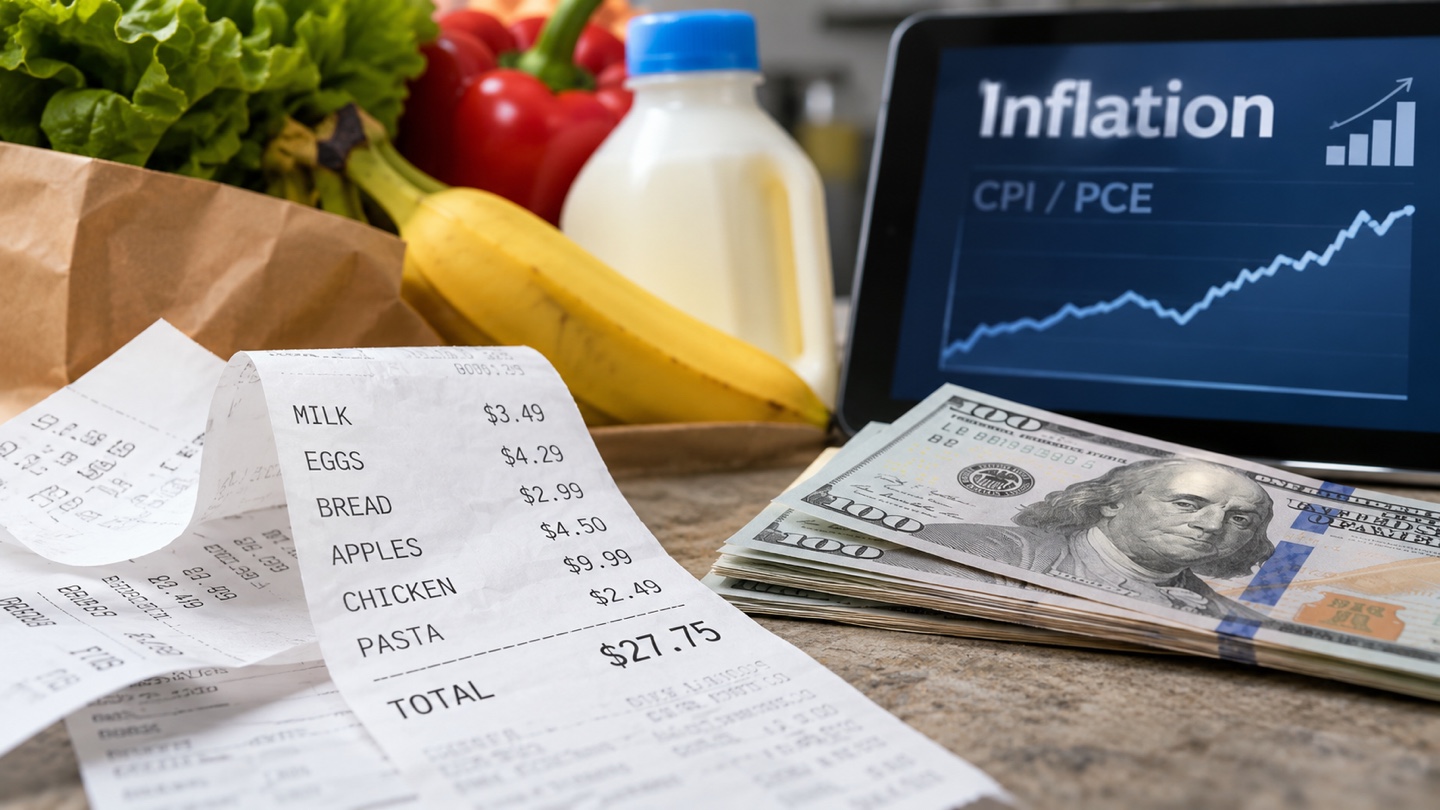
Inflation remains one of the most influential economic variables in financial markets.
It affects household purchasing power, corporate operating costs, monetary policy and the valuation of financial assets.
However, inflation is measured through several different indicators.
The Consumer Price Index and the Personal Consumption Expenditures Price Index are among the most important US inflation measures.
Understanding their differences helps investors interpret economic releases without assuming that every reported inflation figure describes the same underlying measurement.
The May 2026 CPI report, published on June 10, provides a useful example.
Historical research edition: June 11, 2026. Includes the original May CPI release published June 10. Subsequent releases and revisions are excluded.
The May 2026 US Inflation Report
According to the Bureau of Labor Statistics, consumer prices increased by 0.5% in May on a seasonally adjusted monthly basis.
This followed an increase of 0.6% in April.
The annual increase in the headline CPI reached 4.2%.
Energy prices increased by 3.9% during May.
Source: US Bureau of Labor Statistics, May 2026 Consumer Price Index release, June 10, 2026. Annual CPI is measured before seasonal adjustment.
These figures demonstrate why monthly and annual inflation should be examined separately.
Monthly inflation declined relative to April, but consumer prices still increased during May.
A slower monthly increase does not mean the overall price level has fallen.
Inflation vs Disinflation
Inflation describes an increase in the general price level.
Disinflation describes a decline in the inflation rate while prices continue rising.
Deflation describes a decline in the general price level.
| Scenario | Inflation Rate | Interpretation |
|---|---|---|
| Year one | 6% | Prices rise |
| Year two | 3% | Prices rise more slowly |
| Year three | 0% | General price level remains stable |
| Year four | −2% | General price level declines |
The distinction is important because households can continue experiencing higher living costs even after inflation slows.
Understanding CPI
The Consumer Price Index measures changes in consumer prices across a defined basket of goods and services.
It includes categories such as housing, transportation, food, medical care and recreation.
Different categories receive weights according to their importance within the measurement framework.
CPI is published by the Bureau of Labor Statistics.
It is widely used in economic analysis, cost of living adjustments and financial market research.
Understanding PCE Inflation
The Personal Consumption Expenditures Price Index is published by the Bureau of Economic Analysis.
It measures prices across a broader consumption framework.
Its coverage includes certain expenditures made on behalf of households, including some healthcare spending financed through third parties.
The methodology can also reflect changes in consumption patterns differently from CPI.
The Federal Reserve defines its longer term inflation objective using the PCE price index.
CPI vs PCE
| Characteristic | CPI | PCE |
|---|---|---|
| Publisher | Bureau of Labor Statistics | Bureau of Economic Analysis |
| Main focus | Consumer price changes | Personal consumption price changes |
| Coverage | Defined consumer expenditure framework | Broader consumption framework |
| Weighting | CPI methodology | Chain weighted expenditure methodology |
| Monetary policy relevance | Important economic indicator | Federal Reserve inflation objective |
The indicators frequently move in similar directions but can produce different numerical results.
Differences in housing weights, healthcare expenditures and methodological construction contribute to those differences.
Headline vs Core Inflation
Headline inflation includes all covered categories.
Core inflation excludes food and energy.
Food and energy prices can experience substantial short term fluctuations.
Removing them can help researchers examine underlying price pressures.
However, core inflation is not a complete measure of household expenses.
Consumers still need food, transportation and energy regardless of their exclusion from a particular analytical measure.
Inflation and Interest Rates
Central banks influence financial conditions through monetary policy.
Persistent inflation can create pressure for restrictive policy.
Weakening inflation and deteriorating economic activity may create different policy considerations.
Interest rate decisions depend on multiple variables rather than a single CPI figure.
The Federal Reserve also considers employment conditions and the broader economic outlook.
Financial markets react not only to announced policy but also to changes in expectations.
Inflation and Bond Prices
Existing fixed rate bonds provide predetermined contractual cash flows.
When market yields rise, the value of those existing cash flows generally declines.
Inflation can contribute to rising nominal yields when investors demand greater compensation for purchasing power erosion.
The sensitivity of a bond depends partly on its duration.
Longer duration securities are generally more sensitive to yield changes than otherwise comparable shorter duration instruments.
Understanding Real Returns
Nominal investment returns measure changes in monetary value.
Real returns adjust for inflation.
Suppose an investment generates a nominal return of 5% while inflation reaches 4%.
The exact real return is approximately:
(1.05 ÷ 1.04) − 1 = 0.96%.
Hypothetical calculation assuming 4% inflation and excluding taxes.
Investors should consider purchasing power rather than focusing exclusively on nominal performance.
Inflation and Stock Valuations
Inflation can influence corporate revenue and expenses.
Companies with strong pricing power may be better positioned to pass increasing costs to customers.
Other businesses may experience declining profit margins if expenses rise faster than revenue.
Higher interest rates can also reduce the present value of expected future corporate earnings.
Businesses whose valuations rely heavily on distant expected profits can be particularly sensitive to changes in discount rates.
These relationships are not uniform across companies or industries.
Inflation and Precious Metals
Gold is frequently considered a potential long term store of purchasing power.
However, its shorter term performance depends on real yields, currency conditions and investment demand.
An inflationary period accompanied by rising real yields may produce different gold market behaviour from a period of falling real yields.
Silver introduces additional industrial demand considerations.
Neither metal provides guaranteed inflation protection over every investment horizon.
Inflation and Digital Assets
Cryptocurrencies are sometimes described as alternatives to inflationary monetary systems.
However, their market prices can be highly sensitive to financial liquidity and speculative demand.
Restrictive monetary conditions may reduce investors' willingness to hold volatile assets.
The existence of a limited token supply does not establish a stable short term relationship with consumer inflation.
Why Markets React to Expectations
A reported inflation figure should be interpreted alongside what investors expected.
A relatively high inflation reading can produce a favorable market reaction if it is lower than anticipated.
A relatively low reading can generate a negative reaction if it exceeds expectations.
The economic release changes market prices partly through its effect on anticipated future conditions.
This is why the direction of asset prices cannot reliably be inferred from the inflation figure alone.
Frequently Asked Questions
Does lower inflation mean lower prices?
Not necessarily. Positive but declining inflation means prices continue rising more slowly.
Which inflation measure does the Federal Reserve target?
Its longer term inflation objective is defined using the PCE price index.
Why are CPI and PCE different?
They use different expenditure coverage, weighting and calculation methodologies.
Does inflation always hurt stocks?
No. Effects depend on corporate pricing power, costs, interest rates and expectations.
What is the difference between nominal and real returns?
Real returns adjust nominal performance for inflation.
Conclusion
The May 2026 CPI release provides an example of why inflation analysis requires more than one headline number.
Monthly changes, annual comparisons and underlying economic conditions should be evaluated together.
CPI and PCE offer complementary perspectives on consumer prices.
Understanding their differences helps investors interpret monetary policy and asset valuation without drawing unsupported conclusions from individual economic releases.
Research Sources
- BLS: May 2026 Consumer Price Index Release, June 10
- BEA: Personal Income and Outlays, April 2026
- Federal Reserve: Monetary Policy
Risk Disclosure
This article is provided for educational purposes. Historical economic data can be revised, and financial market reactions remain uncertain. Nothing in this article constitutes personalized investment advice.