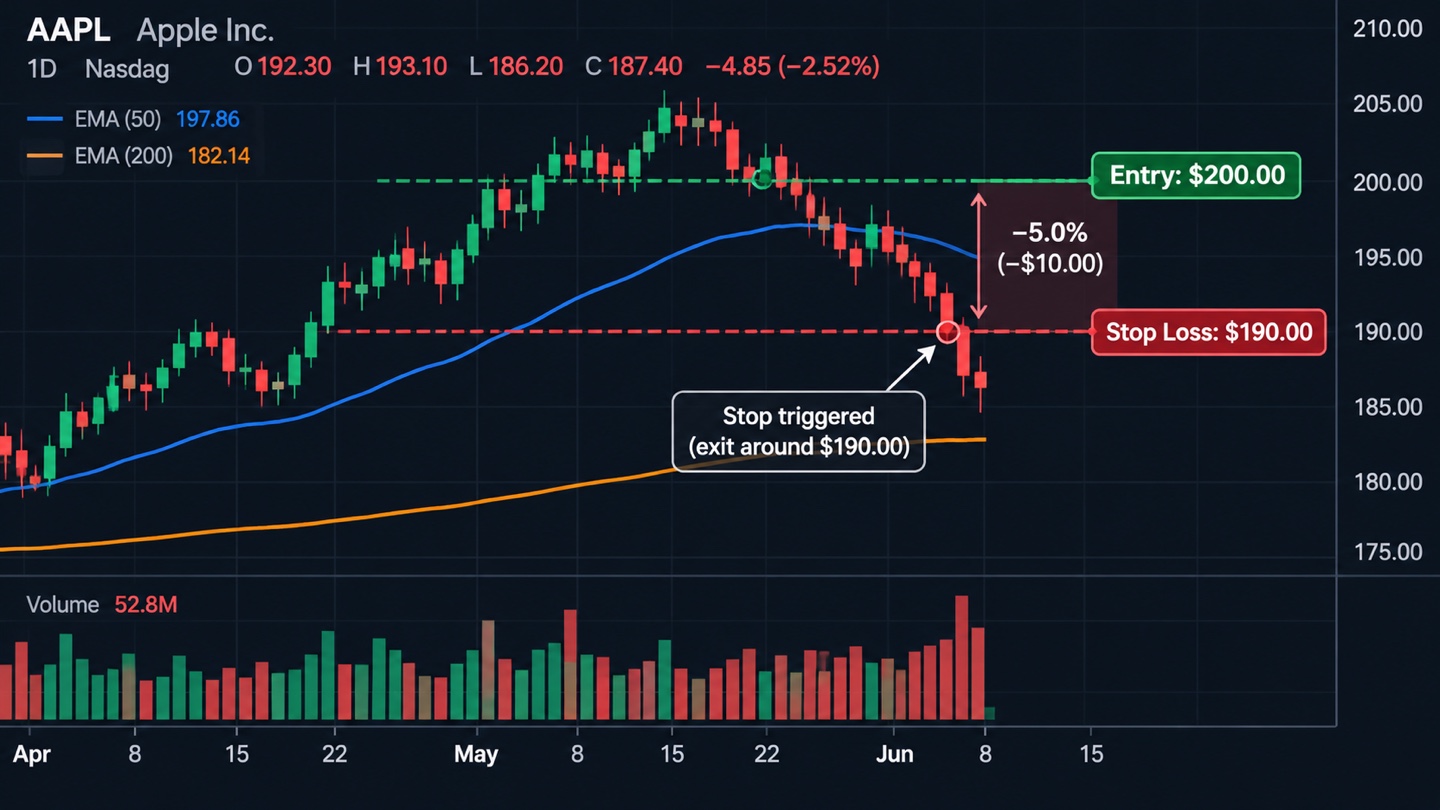
Financial market participants frequently focus on identifying favorable investment opportunities.
However, managing unfavorable outcomes is equally important.
Stop loss orders provide one mechanism for defining conditional exits from financial positions.
They can help investors establish a predetermined response to adverse market movements.
Nevertheless, a stop loss order should not be confused with guaranteed financial protection.
Execution prices can differ from trigger prices, and certain order types may remain unfilled.
Understanding these distinctions is essential when incorporating stop orders into a risk management framework.
Historical research edition: June 10, 2026. All prices, order examples and financial outcomes are hypothetical.
What Is a Stop Loss?
A stop loss describes a conditional exit mechanism intended to reduce or close financial exposure when specified market conditions occur.
For a conventional long position, a sell stop can be placed below the current market price.
For a short position, a buy stop can be placed above the current market price.
The exact activation and execution rules depend on the trading venue, broker and financial instrument.
The stop price establishes a trigger rather than necessarily determining the eventual execution price.
Stop Market Orders
A stop market order generally becomes a market order when the relevant stop condition is triggered.
The objective is to prioritize execution after activation.
Consider a hypothetical investor purchasing 100 shares at $50.
The investor establishes a sell stop at $47.
If the stop triggers and all shares execute at $47, the gross trading loss is $300.
However, the execution could occur below that price if available market liquidity changes.
| Execution Scenario | Exit Price | Gross Loss |
|---|---|---|
| Execution at trigger | $47 | $300 |
| Moderate adverse slippage | $46 | $400 |
| Significant price gap | $42 | $800 |
| Severe market disruption | $35 | $1,500 |
These figures exclude commissions and other costs.
Important Execution Risk
A stop market order does not guarantee execution at its trigger price. During gaps, volatile trading or limited liquidity, realized losses can exceed the original estimate.
Stop Limit Orders
A stop limit order generally becomes a limit order after the stop condition is triggered.
The limit price establishes the minimum acceptable execution price for a sell order or maximum acceptable execution price for a buy order.
This provides greater control over acceptable prices but introduces execution uncertainty.
Consider a long position with a sell stop at $47 and a limit price of $46.
If the market moves below $46 before sufficient execution becomes available, the order may remain partially or entirely unfilled.
The investor continues to hold the remaining exposure.
Stop Market vs Stop Limit
| Feature | Stop Market | Stop Limit |
|---|---|---|
| Activation condition | Stop trigger | Stop trigger |
| Order after activation | Market order | Limit order |
| Price protection | Limited | Specified limit |
| Execution priority | Generally higher | Conditional |
| Main risk | Adverse execution price | Failure to execute |
Neither order type removes market risk.
The appropriate interpretation depends on whether execution certainty or price control is more important under the circumstances.
Understanding Trailing Stops
A trailing stop adjusts its trigger reference as the market moves favorably.
For a conventional long position, the trailing reference can rise when the market establishes higher eligible prices.
The trigger generally does not move downward merely because the market declines.
Suppose an investor purchases an asset at $100 and uses a hypothetical trailing distance of 10%.
| Highest Reference Price | Trailing Stop Reference |
|---|---|
| $100 | $90 |
| $110 | $99 |
| $120 | $108 |
| $130 | $117 |
| $150 | $135 |
The precise reference price and activation rules depend on the venue.
Hypothetical illustration. The displayed trigger is not a guaranteed execution price.
Trailing stops can help define exit behaviour without repeatedly adjusting an order manually.
However, a relatively narrow trailing distance can result in exits during ordinary market fluctuations.
Fixed Percentage Stops
A fixed percentage stop establishes an exit reference at a specified percentage distance from an entry or other reference price.
This approach is straightforward to calculate.
For an asset purchased at $100, a 5% stop distance corresponds to an initial trigger reference of $95.
The principal limitation is that financial assets exhibit different volatility characteristics.
A 5% movement may be unusual for one asset and routine for another.
A fixed percentage should therefore not be treated as equally appropriate across all markets.
Market Structure Based Stops
Some traders examine previous support and resistance areas when evaluating exit references.
The objective is to identify conditions that would challenge the original market interpretation.
For example, a market hypothesis may rely on continued trading above a historical support region.
A sustained move below that region could provide evidence that the hypothesis requires reassessment.
However, technical price zones are not guaranteed barriers.
Temporary movements beyond previous levels are possible.
Read our support and resistance research for additional context.
Volatility Based Stops
Volatility based approaches adjust potential exit distances according to the observed variability of a financial instrument.
Average True Range, commonly known as ATR, is one measure used in technical analysis.
It incorporates price ranges and gaps between trading periods.
A higher ATR generally indicates greater recent price variability.
Consider two hypothetical assets trading at $100.
| Measure | Asset A | Asset B |
|---|---|---|
| Current price | $100 | $100 |
| Illustrative ATR | $1 | $5 |
| Two ATR distance | $2 | $10 |
| Illustrative long exit reference | $98 | $90 |
The wider distance for Asset B reflects its greater measured volatility.
This does not mean that either exit reference guarantees protection or optimal investment performance.
ATR describes historical price variability rather than maximum future losses.
Position Sizing and Stop Distance
Stop distance and position quantity should be considered together.
A wider exit distance can increase the estimated loss per unit.
If a fixed risk budget is maintained, the calculated quantity must decrease.
Simplified Risk Relationship
Planned Loss = Quantity × Assumed Exit Distance
This calculation assumes execution at the planned reference and excludes transaction costs.
Consider a hypothetical planned risk budget of $200.
| Exit Distance Per Unit | Calculated Position Quantity |
|---|---|
| $1 | 200 |
| $2 | 100 |
| $4 | 50 |
| $5 | 40 |
The same estimated loss can correspond to substantially different quantities.
Our position sizing research examines this relationship in greater detail.
Price Gaps and Execution Risk
Financial markets can move between trading periods without executing at every intermediate price.
Unexpected corporate announcements, economic developments and changes in market expectations can produce substantial gaps.
A stock closing at $50 may subsequently reopen at $42.
A sell stop at $47 does not ensure that an execution at $47 will be available.
Similar execution differences can occur during continuous cryptocurrency trading when liquidity changes rapidly.
The Problem With Excessively Tight Stops
Very narrow stop distances may reduce the theoretical loss per unit.
However, they can increase sensitivity to ordinary market variability.
Frequent exits and subsequent transactions can generate commissions, spreads and other costs.
A strategy must therefore be evaluated using actual execution assumptions rather than exclusively theoretical chart outcomes.
A small planned loss is not necessarily advantageous when the associated exit occurs unusually frequently.
Portfolio Level Downside Management
Individual stop orders do not address every form of portfolio risk.
Multiple positions can respond negatively to the same economic development.
During financial stress, correlations may increase and available liquidity may deteriorate.
An investor holding several positions may therefore experience simultaneous exits at unfavorable prices.
Portfolio level risk management should consider:
- Aggregate market exposure.
- Shared economic risk factors.
- Position concentration.
- Available liquidity.
- Financing obligations.
- Potential price gaps.
Stop orders represent only one component of this broader assessment.
Leveraged Positions and Liquidation
Leveraged instruments introduce additional margin and liquidation considerations.
A trading venue may reduce or close positions when collateral becomes insufficient.
This can occur independently of an investor's intended exit plan.
An order placed beyond the relevant liquidation threshold may not provide its intended protection.
Investors should understand contract specifications and margin rules before evaluating conditional exits.
Common Stop Loss Mistakes
Confusing the Trigger With the Execution Price
The trigger activates the order under specified conditions. It does not necessarily determine the realized execution price.
Moving the Stop Without Reassessing Risk
Changing an exit reference can increase potential losses. The financial implications should be recalculated.
Ignoring Ordinary Market Volatility
An exit distance that is too narrow relative to typical price variability may produce frequent unintended exits.
Ignoring the Entire Portfolio
Several individually controlled positions can still produce excessive combined exposure.
Assuming Stop Orders Cannot Fail
Trading interruptions, liquidity problems and platform restrictions can interfere with intended execution.
Frequently Asked Questions
Does a stop loss guarantee my maximum loss?
No. Ordinary stop market orders can experience adverse execution differences.
Can stop limit orders remain unfilled?
Yes. Execution may be unavailable within the specified acceptable price range.
What is a trailing stop?
It is a conditional order whose reference can adjust when the market moves favorably.
Is there an ideal stop distance?
No. Appropriate distances depend on the instrument, market conditions and investment framework.
Should long term investors always use stop orders?
No. The suitability of conditional exits depends on investment objectives, costs, financial circumstances and risk tolerance.
Conclusion
Stop orders can provide structure to downside management by defining conditional responses to market movements.
However, their limitations are as important as their intended benefits.
Price gaps, liquidity conditions, order specifications and portfolio exposure can substantially influence realized outcomes.
Effective risk management requires understanding these mechanisms before relying on them.
Research Sources
Risk Disclosure
This article is educational and does not recommend specific trading strategies. All prices and examples are hypothetical. Stop orders do not eliminate market risk or guarantee execution at specified prices. Leveraged instruments can create substantial financial losses.