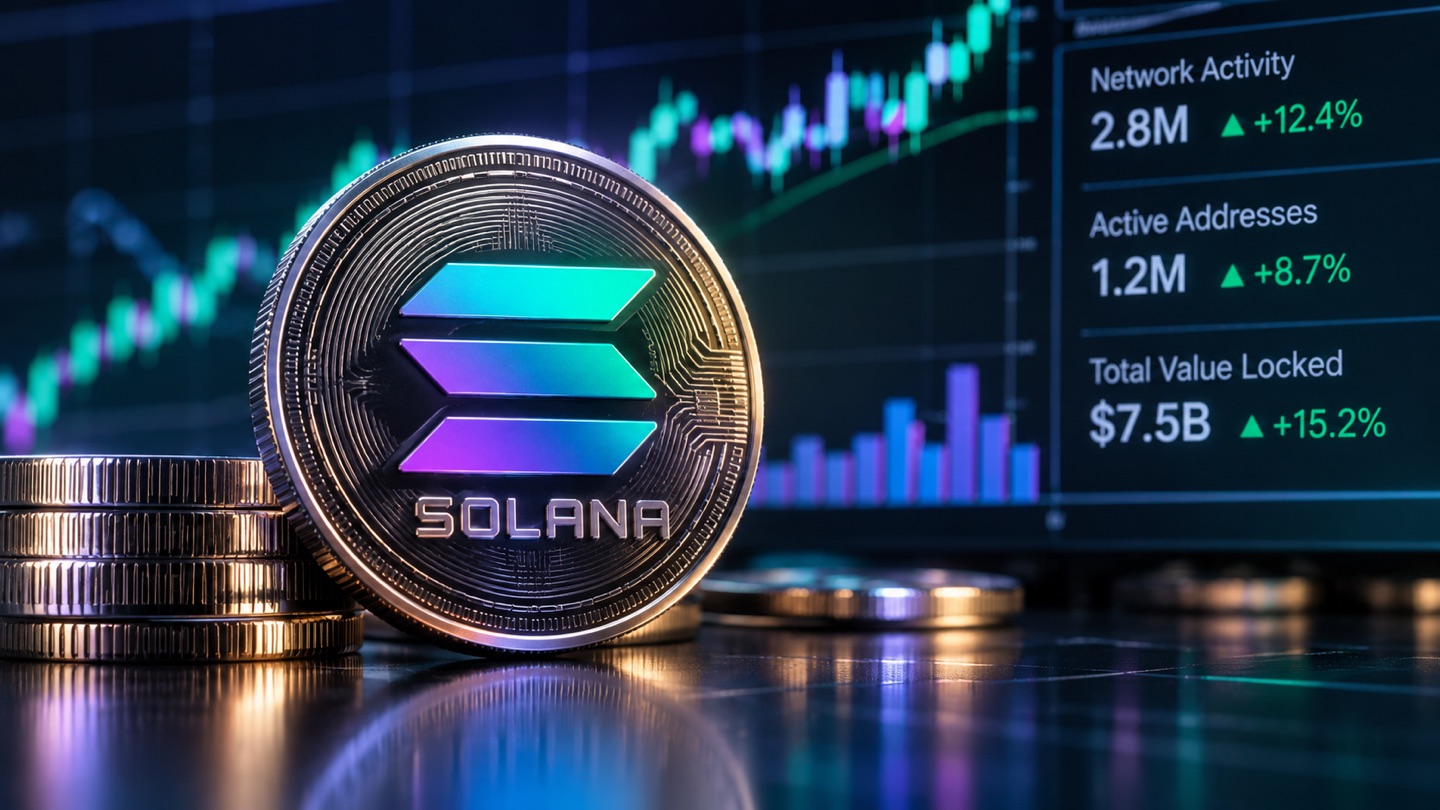
Solana is a blockchain network designed to support applications requiring relatively fast transaction processing and low transaction costs.
Its ecosystem includes decentralized exchanges, payment infrastructure, digital assets, lending applications and consumer facing services.
However, evaluating Solana exclusively through transaction throughput can produce an incomplete investment picture.
A network can process substantial activity while generating relatively modest fees.
Similarly, growing application adoption does not necessarily produce proportional appreciation in its native asset.
Understanding the economic relationship between the Solana network and SOL is essential when evaluating its investment characteristics.
Historical research edition: June 13, 2026. Prepared retrospectively. No subsequent network statistics or market prices are included.
What Does SOL Do?
SOL is the native asset of the Solana network.
It performs several economic functions.
| Function | Description |
|---|---|
| Transaction fees | Payment for network execution |
| Staking | Economic participation in network consensus |
| Collateral | Potential use within financial applications |
| Trading | Exchange against other digital assets |
| Liquidity | Participation in decentralized markets |
These functions create potential sources of demand.
However, their economic importance can change as network usage, application design and market conditions evolve.
Understanding Solana's Network Design
Solana combines a proof of stake consensus environment with techniques intended to improve transaction processing efficiency.
Proof of History provides a mechanism for establishing verifiable ordering information.
It should not be confused with the entire consensus system.
The network can execute certain transactions in parallel when their account access requirements permit.
This differs from processing every transaction through a strictly sequential execution model.
The benefits depend on application design, transaction complexity and network conditions.
Why Transaction Counts Require Context
High transaction counts are frequently presented as evidence of blockchain adoption.
However, blockchain transactions do not necessarily correspond to unique users or independent economic activities.
A single user can generate numerous transactions.
Automated trading systems may submit large numbers of transactions.
Some reported Solana transaction metrics also include validator voting activity.
Researchers should therefore distinguish between total network transactions, user transactions, successful execution and economically meaningful activity.
Evaluating Network Usage
Useful research dimensions include:
- Successful user transactions.
- Active fee paying accounts.
- Application level activity.
- Stablecoin transfer volumes.
- Transaction fees.
- Validator participation.
- Network reliability.
Each indicator has limitations.
Active accounts do not directly measure unique individuals, and transfers between related wallets can increase reported settlement volumes without representing new economic demand.
Transaction Fees and Network Economics
Solana transactions require fees paid in SOL.
The network uses base fees and can support additional prioritization fees.
Base fee calculations depend on transaction signatures.
Priority fees can influence execution priority under relevant network conditions.
These fees help compensate validators and contribute to the network's economic mechanisms.
However, the total value transferred by users is not equivalent to the amount of fees collected.
A Hypothetical Fee Comparison
Hypothetical arithmetic example. These are not observed Solana network statistics.
Low transaction fees can improve accessibility and support application growth.
At the same time, sustainable economic demand requires consideration of transaction quantity, fee levels and other sources of network participation.
Solana Staking
SOL holders can delegate eligible balances to validators.
Delegation allows holders to participate economically in network staking without operating independent validator infrastructure.
Rewards depend on protocol issuance, validator performance, commission arrangements and other applicable factors.
Staking does not eliminate exposure to SOL price fluctuations.
Illustrative Staking Returns
Consider a hypothetical investor with 100 SOL receiving 5% in annual staking rewards.
| Measure | Value |
|---|---|
| Starting balance | 100 SOL |
| Assumed annual reward | 5% |
| Additional SOL | 5 SOL |
| Final balance | 105 SOL |
The calculation excludes compounding, taxes, commissions and changes in reward rates.
If SOL subsequently declines by 40% in market value, the investor's portfolio would be worth approximately 37% less than its initial value despite earning additional tokens.
This demonstrates the distinction between token denominated rewards and investment performance.
Inflation and Token Supply
Solana uses protocol issuance to support network security and validator participation.
Investors should distinguish the nominal staking reward from the change in their relative ownership of the overall token supply.
For example, an investor earning 6% more tokens while total supply grows by 4% does not increase their relative ownership by the full 6%.
The simplified relative change would be approximately 1.92%.
Actual supply economics also depend on burning, circulation changes and other mechanisms.
Stablecoins and Payment Infrastructure
Low transaction costs can make blockchain networks attractive for transferring stablecoins.
Potential applications include merchant settlement, cross border transfers and programmable payments.
However, stablecoin transaction volume does not represent equivalent SOL investment demand.
A user can transfer a substantial stablecoin balance while paying only a small transaction fee.
This creates a distinction between the monetary value passing through the network and the economic value retained by its infrastructure.
Decentralized Finance on Solana
Solana supports applications that provide token exchanges, lending and other financial services.
These applications can attract users and liquidity.
Nevertheless, decentralized financial activity introduces additional risks, including smart contract vulnerabilities, price oracle problems and collateral liquidation.
Application revenue may accrue to application operators, liquidity providers or other participants rather than directly to SOL holders.
Researchers should distinguish application economics from network economics.
Comparing Solana and Ethereum
| Dimension | Solana | Ethereum |
|---|---|---|
| Execution architecture | Supports parallel execution where account access permits | Main network execution with extensive external scaling ecosystem |
| Native asset | SOL | ETH |
| Security participation | Proof of stake | Proof of stake |
| Scaling approach | Strong emphasis on main network performance | Main network and rollup ecosystem |
| Transaction costs | Designed for relatively low fees | Vary by network layer and activity |
Neither network should be evaluated through a single performance metric.
Developer adoption, security, reliability, liquidity and economic sustainability all matter.
For a complementary perspective, read our Ethereum network economics research.
Validator and Infrastructure Risks
A blockchain network depends on infrastructure operators.
Validator concentration, hardware requirements and reliance on shared software implementations can influence resilience.
Technical improvements may reduce certain risks, but no complex distributed network is immune to operational disruptions.
Investors should examine demonstrated reliability rather than relying solely on stated performance capabilities.
A Framework for SOL Valuation
SOL does not provide a conventional equity ownership claim.
Applying stock valuation ratios directly can therefore be misleading.
A research framework can consider:
| Dimension | Relevant Question |
|---|---|
| Adoption | Are economically meaningful applications attracting users? |
| Network economics | Does activity generate sustainable demand for network resources? |
| Token supply | How do issuance and burning affect ownership economics? |
| Staking | What rewards and risks accompany participation? |
| Competition | Can alternative networks provide comparable services? |
| Reliability | Can the network maintain consistent operation under demand? |
A growing ecosystem can improve the investment narrative without establishing a particular fair market price.
Frequently Asked Questions
Does Solana's transaction count represent unique users?
No. Users, automated systems and validator activity can generate multiple transactions.
Is SOL staking guaranteed income?
No. Rewards vary and the asset remains exposed to substantial market risk.
Does stablecoin growth automatically increase SOL prices?
No. Network usage and native asset valuation are related but distinct.
Is Solana a proof of stake network?
Yes. Its consensus environment uses proof of stake alongside other network mechanisms.
Can Solana replace every competing blockchain?
There is no established basis for that conclusion. Different networks offer different economic and technical characteristics.
Conclusion
Solana provides infrastructure for applications requiring efficient blockchain execution.
Its economic potential depends on more than transaction throughput.
Sustainable adoption, network fees, staking participation, monetary economics and infrastructure resilience all contribute to the broader investment assessment.
A disciplined approach distinguishes network growth from assumptions about future SOL prices.
Research Sources
- Solana Developer Documentation
- Solana Transaction Fees
- Solana Staking Information
- Ethereum Developer Documentation
Risk Disclosure
This article provides educational information rather than a recommendation to purchase or stake SOL. Digital assets involve substantial market, technological and regulatory risks. All numerical investment examples are hypothetical.