Historical research edition: July 23, 2026. Prepared retrospectively using information published through July 22, 2026. Numerical payment and valuation scenarios are hypothetical unless attributed to a dated source.
Blockchain adoption increasingly extends beyond speculative cryptocurrency trading.
Financial institutions and technology companies are investigating distributed infrastructure for payments, securities representation, collateral management and programmable settlement.
Solana occupies a distinctive position within this development because its architecture supports relatively low transaction costs and high throughput.
During July 2026, developments involving tokenized securities provided additional evidence of expanding financial applications.
On July 9, reporting confirmed that Ondo Finance had introduced continuous minting and redemption for six selected tokenized assets on Solana.
This followed an earlier announcement concerning expanded access to tokenized securities outside conventional securities market operating hours.
However, the investment significance of such developments cannot be established solely through transaction counts or headline asset values.
The relevant question is whether applications produce durable economic activity, generate sustainable network demand and create meaningful value capture for the underlying infrastructure.
Key Findings
Solana Adoption Research Highlights
- Selected Ondo tokenized securities became available for continuous minting and redemption on Solana in July.
- Tokenized securities can provide exposure through contractual structures that differ from direct share ownership.
- Blockchain settlement availability does not eliminate the operating restrictions of underlying financial markets.
- Stablecoin transfer volume and network revenue describe different economic quantities.
- Application growth does not automatically produce proportional demand for SOL.
- Reliable infrastructure, legal compliance and asset custody remain essential for financial adoption.
- Native token valuation depends on both economic demand and supply characteristics.
July 2026 Tokenized Securities Developments
Ondo Finance announced its initial continuous minting and redemption initiative on June 25.
Subsequent reporting on July 9 confirmed expansion of the functionality to Solana.
The initially supported instruments included tokenized exposure to selected US equities and exchange traded funds.
| Tokenized instrument | Underlying reference exposure |
|---|---|
| NVDAon | NVIDIA shares |
| TSLAon | Tesla shares |
| GOOGLon | Alphabet shares |
| SPYon | SPDR S&P 500 ETF Trust |
| QQQon | Invesco QQQ Trust |
| CRCLon | Circle Internet Group shares |
These instruments should not automatically be interpreted as direct registered ownership of the corresponding securities.
Their legal characteristics depend on the issuer, governing documentation and applicable jurisdiction.
Continuous minting and redemption also remains subject to eligibility, product conditions and operational restrictions.
Why Tokenization Matters
Tokenization involves representing specified rights or economic exposure through digital records that can be transferred using blockchain infrastructure.
A token may represent exposure to a financial instrument, a payment claim or another contractual arrangement.
The blockchain provides a mechanism for recording and transferring the token.
However, the legal relationship between the token and its referenced asset exists through additional contractual and institutional arrangements.
| Token category | Possible economic function |
|---|---|
| Stablecoin | Currency referenced payment or settlement |
| Tokenized equity | Exposure linked to company shares |
| Tokenized government debt | Exposure to specified debt instruments |
| Tokenized fund | Representation of fund related rights |
| Native blockchain token | Network fees, security or other protocol functions |
These categories differ in their legal structure and economic risks.
A token's existence on a public blockchain does not independently establish its enforceability or the quality of the underlying assets.
Direct Securities Ownership Versus Tokenized Exposure
Conventional securities can provide voting rights, dividend entitlements and other legal protections depending on their structure.
A tokenized representation may provide different rights.
Investors should determine whether they hold the underlying security itself, a beneficial interest, a contractual claim against an issuer or another form of economic exposure.
| Research question | Why it matters |
|---|---|
| Who issues the token? | Identifies the responsible legal entity |
| Who holds the underlying assets? | Establishes custody arrangements |
| Can tokens be redeemed? | Determines available conversion mechanisms |
| Who receives distributions? | Clarifies economic rights |
| Are voting rights included? | Establishes governance participation |
| What happens during insolvency? | Identifies potential creditor exposure |
| Who is eligible to hold the token? | Determines jurisdictional and transfer restrictions |
The answers can vary substantially between products.
A token referencing a publicly traded company should not be assumed to provide every right available to a conventional shareholder.
Continuous Trading Versus Continuous Redemption
Blockchain infrastructure can operate outside conventional securities exchange schedules.
However, several different activities must be distinguished.
A token may be transferable between wallets at any time.
It may also trade in a secondary marketplace while the underlying securities exchange is closed.
Minting and redemption concern the creation or removal of tokenized instruments through the issuer's supported mechanisms.
| Activity | Main economic function |
|---|---|
| Blockchain transfer | Changes token ownership |
| Secondary token trade | Exchanges existing token exposure |
| Minting | Creates additional tokenized exposure |
| Redemption | Removes or converts tokenized exposure |
| Underlying securities trading | Exchanges the conventional financial instrument |
Continuous access to one activity does not guarantee continuous access to every other activity.
Ondo's July expansion was notable because it addressed minting and redemption availability for selected products rather than only allowing wallet transfers.
Nevertheless, issuer risk controls and exceptional conditions can affect availability.
Pricing Outside Conventional Market Hours
When an underlying securities market is closed, tokenized markets may continue receiving new information.
Investors could respond to corporate announcements, macroeconomic developments or geopolitical events.
However, available pricing references and market making arrangements may differ from normal exchange hours.
Consider a hypothetical stock closing its conventional trading session at $100.
A tokenized representation subsequently trades at $104 following unexpected news.
| Observation | Hypothetical price |
|---|---|
| Underlying stock closing reference | $100 |
| Tokenized secondary market price | $104 |
| Difference from previous underlying close | 4% |
The difference does not necessarily represent an arbitrage opportunity.
The underlying security may be unavailable for immediate trading, and its next opening price could differ substantially from the previous close.
Transaction costs, issuer arrangements and hedging limitations can also influence the relationship.
Stablecoins and Programmable Settlement
Stablecoins can provide currency referenced settlement assets within blockchain applications.
Their use can allow participants to transfer financial value without requiring every intermediate transaction to settle through conventional banking hours.
Potential applications include merchant payments, cross border transfers, securities purchases and treasury management.
However, blockchain settlement represents only one component of a complete payment process.
An international payment may require identity verification, foreign exchange conversion, local banking integration and compliance checks.
These activities can introduce additional costs and delays.
Blockchain Confirmation Versus Completed Payment
A confirmed blockchain transaction does not necessarily establish that the recipient has completed every financial step associated with a payment.
Consider a hypothetical international business payment.
| Payment stage | General function |
|---|---|
| Customer onboarding | Identity and eligibility verification |
| Funding | Conversion of existing money into settlement assets |
| Blockchain transfer | Movement of tokens to the recipient |
| Compliance processing | Transaction monitoring and required controls |
| Redemption | Conversion into conventional money where required |
| Bank settlement | Delivery into the recipient's account |
A fast blockchain transfer can improve one part of this workflow.
The end to end service still depends on the availability and efficiency of other participants.
Claims about payment speed should therefore identify the specific process being measured.
Reported Adoption Before the July Research Cutoff
The Solana Foundation's June ecosystem review, published July 6, reported several developments relating to financial assets and payments.
The report stated that the value of real world assets represented on Solana had exceeded $3 billion.
It also identified cumulative tokenized stock trading volume exceeding $10 billion.
These are ecosystem reported measurements and should not be treated as independently audited network revenue.
| Reported ecosystem indicator | Reported milestone |
|---|---|
| Real world asset value | Above $3B |
| Cumulative tokenized stock volume | Above $10B |
The report also discussed a June 22 strategic agreement involving Toss Bank and the Solana Foundation to explore blockchain based remittance infrastructure.
Such an agreement indicates institutional interest and potential future development.
It does not establish completed commercial deployment or guaranteed future transaction volumes.
Why Tokenized Asset Value Is Not Network Revenue
Asset value describes the amount of financial exposure represented within a particular system.
Network revenue concerns payments generated through the provision of network services under a specified accounting framework.
These are fundamentally different measurements.
Consider a hypothetical tokenized fund holding $100 million in underlying assets.
If its holdings appreciate by 10%, the represented asset value increases to $110 million.
No additional investor deposits are required for that valuation change.
The blockchain also does not automatically receive $10 million of revenue.
Researchers must distinguish asset appreciation, issuance, trading volume and the fees generated by actual network usage.
Payment Volume and Network Fee Economics
Consider a hypothetical payment application processing one million transactions.
Assume each transaction transfers an average of $100 and incurs an average total network fee of $0.002.
| Measurement | Illustrative result |
|---|---|
| Transaction count | 1,000,000 |
| Average payment value | $100 |
| Gross payment volume | $100M |
| Average network fee | $0.002 |
| Aggregate network fees | $2,000 |
The payment application transfers $100 million of value while generating only $2,000 in assumed network fees.
This illustrates a fundamental distinction in blockchain economics.
High transfer volumes can coexist with comparatively low direct network fee generation.
Low fees may make the infrastructure commercially attractive to users, but they can also limit the revenue generated per transaction.
Scaling Usage and Fee Generation
Consider three hypothetical levels of payment activity under an unchanged average network fee.
| Annual transactions | Average fee | Aggregate network fees |
|---|---|---|
| 1 million | $0.002 | $2,000 |
| 100 million | $0.002 | $200,000 |
| 1 billion | $0.002 | $2 million |
Network fees increase proportionally with transaction activity under the stated assumptions.
Actual fees can vary according to transaction requirements and network conditions.
The table does not represent actual Solana revenue or a forecast.
It demonstrates why researchers must evaluate economic activity using both usage quantities and the revenue generated per unit.
SOL and Transaction Fees
SOL serves several functions within the Solana network, including payment of transaction fees and participation in staking.
Transactions can involve a base fee and additional prioritization fees depending on their characteristics.
Solana's official documentation describes the applicable fee mechanisms.
However, not every fee generated by an application or marketplace necessarily represents revenue attributable to the native token.
An application can charge its own commercial expenses separately from blockchain transaction fees.
Researchers should identify the recipient and economic treatment of each fee category.
For more detail, see our Solana network economics research.
Fee Sponsorship and User Experience
Financial applications may abstract some blockchain infrastructure requirements from customers.
For example, a payment provider could arrange for a separate account to cover network transaction fees.
The customer may interact with the service without directly managing a substantial SOL balance.
This can improve accessibility.
However, it also demonstrates why increasing application adoption does not necessarily require every individual customer to purchase and maintain significant native token holdings.
The network can experience growing usage while fee payment responsibilities remain concentrated among service providers.
Staking and Network Security
Solana uses staking as part of its network security framework.
Token holders may participate through arrangements involving validators.
Staking rewards can increase the quantity of SOL held by participants.
However, the economic outcome also depends on token issuance, validator commission, operational performance and market valuation.
Consider a hypothetical annual token return of 6% and total supply growth of 4%.
The simplified change in relative supply share is:
1.06 / 1.04 - 1 = 1.92%
This is not a forecast of Solana staking performance.
It illustrates the difference between nominal token accumulation and growth relative to the overall supply.
For additional context, see our tokenomics and dilution research.
Transaction Counts and Measurement Quality
Reported blockchain transactions can represent different activities.
They may include user payments, application interactions, internal transfers and protocol related operations.
Raw transaction counts do not necessarily establish unique customer participation.
| Metric | Important limitation |
|---|---|
| Transaction count | Can include different transaction categories |
| Active addresses | One person may control multiple addresses |
| Stablecoin volume | Can include repeated or internal transfers |
| Asset value | Changes with underlying market prices |
| Application revenue | May not accrue to native token holders |
| Network fees | Depend on usage and fee structure |
| Token holder count | Addresses do not establish unique individuals |
Researchers should use consistent definitions and investigate whether the selected dataset removes economically repetitive activity.
A meaningful adoption assessment requires more than identifying the largest available activity statistic.
Operational Infrastructure Requirements
Financial applications require reliable infrastructure beyond the blockchain itself.
Important components include wallet management, transaction submission services, data indexing and integration with external payment providers.
| Infrastructure component | Main responsibility |
|---|---|
| Wallet software | Manages signing and user interaction |
| RPC services | Connect applications to blockchain infrastructure |
| Indexing systems | Organize transaction and account information |
| Custody systems | Protect controlled financial assets |
| Payment integrations | Connect settlement assets with payment channels |
| Monitoring systems | Identify failures and operational issues |
A blockchain can remain operational while an individual service provider experiences an interruption.
Application reliability therefore depends on the complete system architecture.
Transaction Confirmation and Settlement Risk
Financial applications must define when a blockchain transaction is considered sufficiently confirmed for the relevant business process.
Different confirmation levels can involve different assumptions about transaction finality.
An application handling customer deposits should also distinguish successful submission from confirmed settlement.
Operational safeguards may include transaction status monitoring, reconciliation and controls preventing duplicate processing.
These requirements become particularly important when an application connects blockchain activity with irreversible external payment obligations.
Stablecoin Issuer Risk
Stablecoin settlement introduces exposure to the organization or mechanism responsible for maintaining the token's reference value.
Relevant considerations include reserve composition, redemption arrangements, regulatory requirements and access restrictions.
Using a stablecoin on Solana does not eliminate these issuer related risks.
An efficient blockchain transfer cannot guarantee the financial quality of the transferred asset.
For broader context, see our stablecoin and global finance research.
Liquidity and Tokenized Asset Redemption
The reference value of a tokenized security may differ from the price available for an immediate secondary market transaction.
Consider a hypothetical token with a reference asset value of $100.
| Available execution price | Difference from reference |
|---|---|
| $100 | 0% |
| $99 | -1% |
| $97 | -3% |
| $95 | -5% |
These differences can arise from liquidity conditions, trading expenses or uncertainty surrounding redemption.
The ability to transfer a token continuously does not guarantee that a buyer will always be available at its reference valuation.
Market depth and issuer redemption arrangements should be evaluated independently.
Institutional Adoption Versus Announcements
Financial infrastructure announcements can represent different stages of development.
A memorandum of understanding may indicate an intention to explore a technology.
A pilot program may demonstrate technical feasibility.
A commercial deployment may provide a service to actual customers.
Sustained usage provides a different level of evidence from the original announcement.
| Development stage | Evidence provided |
|---|---|
| Strategic announcement | Organizational interest |
| Technical pilot | Initial feasibility |
| Commercial launch | Product availability |
| Recurring usage | Evidence of continuing demand |
| Sustainable financial results | Evidence of economic viability |
Investors should avoid assigning identical economic significance to every partnership announcement.
Native Token Valuation
SOL valuation depends on more than transaction fee generation.
Potential economic influences include staking demand, collateral usage, liquidity, supply expectations and the perceived future relevance of the network.
However, none of these relationships provides a guaranteed valuation outcome.
Consider a hypothetical native asset supply of 600 million tokens.
| Assumed aggregate valuation | Implied token price |
|---|---|
| $30B | $50 |
| $60B | $100 |
| $120B | $200 |
| $180B | $300 |
These figures use a fictional supply assumption for educational purposes.
They are not verified July SOL supply data or price targets.
Future valuations require independently justified assumptions about demand and the relevant circulating supply.
Major Risks Facing Solana Financial Adoption
Regulatory and legal uncertainty
Tokenized securities and payment products may face different requirements across jurisdictions.
Custody and issuer risk
Blockchain records do not eliminate risks associated with underlying assets or responsible legal entities.
Application security
Smart contract vulnerabilities can affect individual services independently of the broader network.
Infrastructure reliability
RPC providers, wallet software and payment integrations can experience operational interruptions.
Economic value capture
Increasing application activity may generate limited direct demand for the native token.
Competition
Other blockchain networks and conventional financial systems may offer alternative settlement arrangements.
Market valuation
Strong technological adoption can already be reflected in investment prices or fail to generate expected financial returns.
Practical Solana Research Framework
Research Consideration
The expansion of tokenized securities and payment applications establishes evidence of infrastructure development. It does not independently establish sustainable network profitability or a justified future SOL valuation.
| Research indicator | Main purpose |
|---|---|
| Tokenized asset value | Scale of represented financial exposure |
| Minting and redemption | Operational access to products |
| Recurring payment volume | Evidence of continued settlement demand |
| Unique user estimates | Participation context |
| Network fees | Economic demand for network resources |
| Application revenue | Commercial performance of individual services |
| SOL supply | Native asset valuation denominator |
| Staking participation | Network security and token allocation |
| Market depth | Realistic execution capacity |
| Operational reliability | Infrastructure performance |
| Issuer documentation | Legal and financial product characteristics |
Conclusion
Solana's July 2026 tokenized securities developments illustrated the expanding use of blockchain infrastructure for conventional financial exposure.
Continuous minting and redemption for selected products represented an important improvement in accessibility outside established securities market schedules.
However, broader adoption requires more than the ability to transfer digital representations of financial assets.
Legal enforceability, custody arrangements, payment integration, liquidity and operational reliability remain essential.
For SOL investors, the central distinction is between economic activity occurring on the network and the value actually captured by its native asset.
A comprehensive assessment must examine both technological adoption and the financial mechanisms connecting that adoption with sustainable demand.
Frequently Asked Questions
What changed for Ondo products in July 2026?
Continuous minting and redemption became available on Solana for an initial group of six selected tokenized assets.
Does tokenized equity guarantee direct shareholder ownership?
No. Legal rights depend on the product structure.
Can tokenized asset prices differ from conventional securities prices?
Yes. Different trading hours, liquidity and redemption conditions can produce differences.
Does stablecoin payment volume equal network revenue?
No. Transfer value and fees measure different economic quantities.
Does every Solana user need to maintain a large SOL balance?
No. Applications can arrange fee payment through other accounts.
Does higher Solana transaction activity guarantee SOL appreciation?
No. Native asset value depends on multiple demand and supply factors.
Is an institutional partnership equivalent to commercial adoption?
No. Deployment and recurring usage provide different evidence from an initial announcement.
Research Sources
- Ondo Finance: Continuous Minting and Redemption for Tokenized Stocks, June 25, 2026
- The Crypto Times: Ondo Expands Solana Tokenized Stock Access, July 9, 2026
- Solana Foundation: June Ecosystem Roundup, Published July 6, 2026
- Solana Developer Documentation
- Solana Transaction Fee Documentation
Risk Disclosure
This article is provided exclusively for educational and informational purposes and does not constitute personalized investment advice.
Historical ecosystem developments are attributed to their respective reporting sources. Ecosystem reported adoption metrics should not be interpreted as independently audited financial results.
All payment, staking and native asset valuation calculations are hypothetical.
Cryptocurrency and tokenized financial products may involve substantial market, legal, custody, operational and liquidity risks.
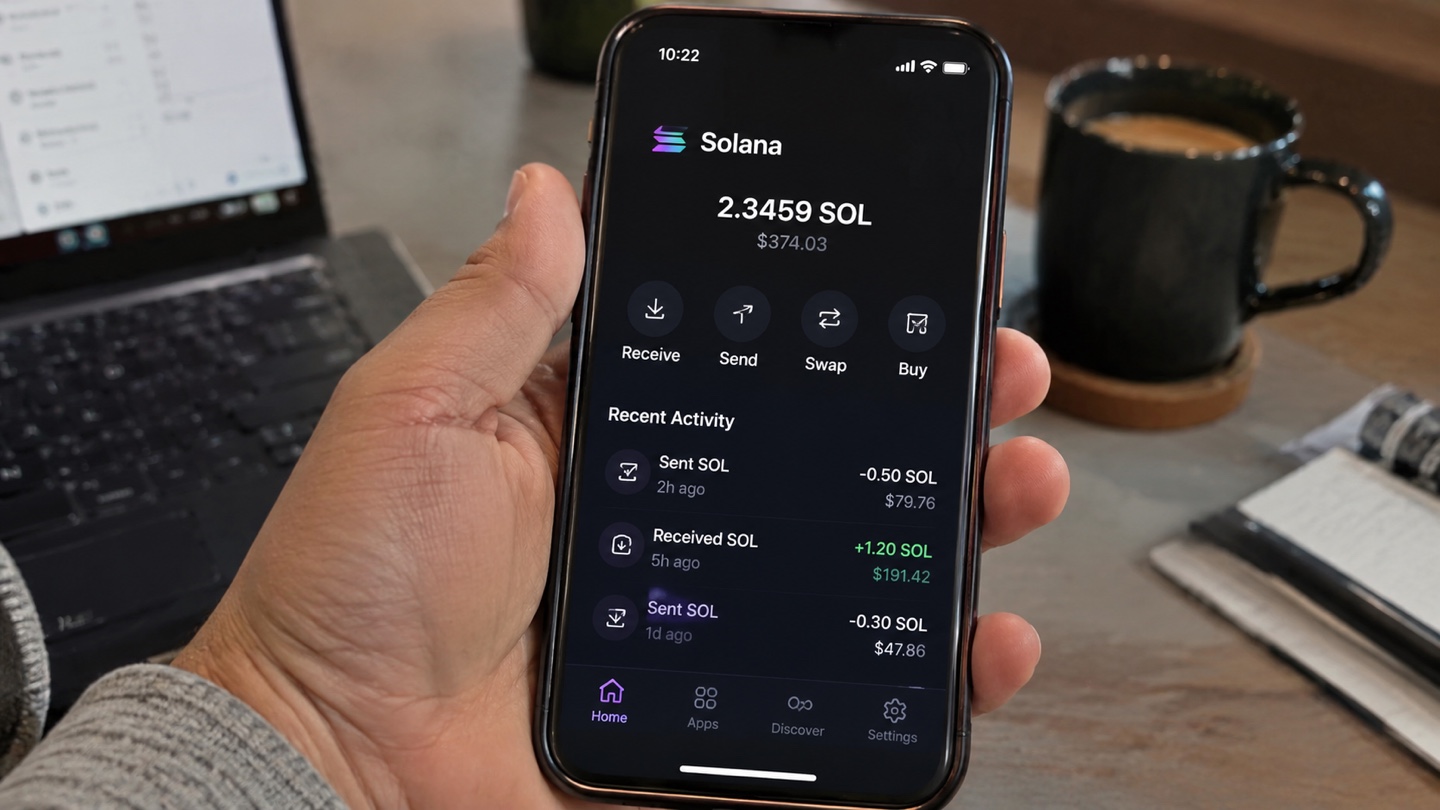
The cover image is illustrative and does not represent documentary evidence of a particular financial application.