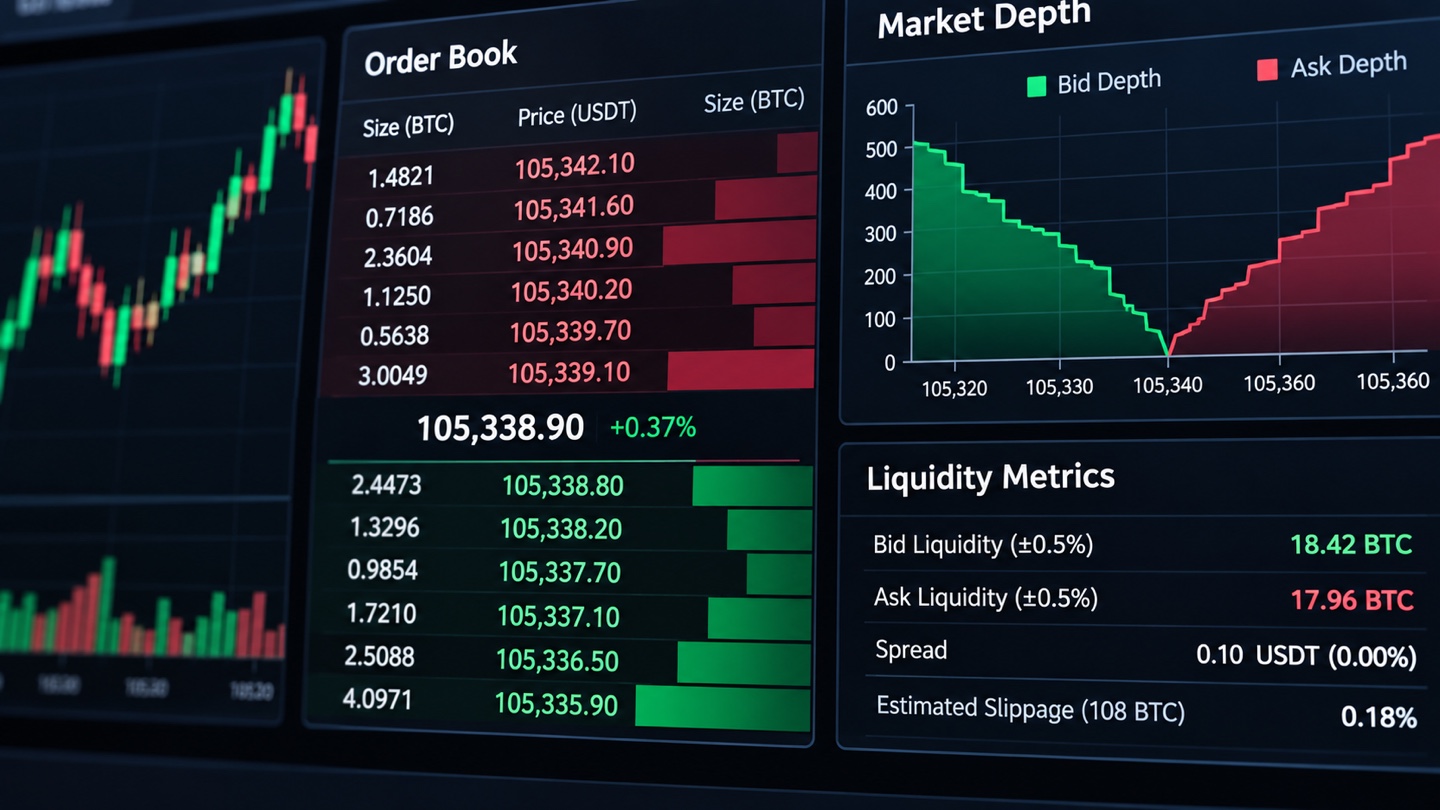
Financial market prices do not exist independently of the transactions that establish them.
An asset may display an attractive quoted price while offering limited liquidity for investors attempting to execute larger transactions.
The difference between a displayed market price and an achievable execution price can materially affect realized investment returns.
Understanding liquidity is therefore essential for evaluating financial instruments, trading costs and market risk.
This is particularly relevant in cryptocurrency markets, smaller company stocks and financial instruments exposed to sudden changes in trading conditions.
Historical research edition: June 29, 2026. All order books, execution examples and quoted prices are hypothetical.
What Is Market Liquidity?
Market liquidity describes the ability to buy or sell a financial instrument without causing a substantial change in its price or incurring excessive execution costs.
A liquid market can generally accommodate transactions with relatively limited price impact.
Liquidity is not a single fixed characteristic.
It can change with transaction size, time of day, available market participants and economic conditions.
Understanding the Order Book
An electronic limit order book displays certain available buying and selling orders at different prices.
Buy orders are commonly called bids.
Sell orders are called asks or offers.
The highest available bid and lowest available ask form the best displayed quotes.
The quantities available at different price levels contribute to displayed market depth.
Hypothetical Order Book
Fictional order book for educational purposes. Quantities represent units available at each displayed price.
The order book demonstrates that different quantities are available at different price levels.
A larger transaction may need to consume several levels of liquidity.
Understanding the Bid and Ask Spread
The spread is the difference between the best available buying and selling quotes.
In our hypothetical order book:
Best bid = $99.90.
Best ask = $100.10.
Spread = $0.20.
The midpoint is $100.00.
The relative spread is therefore 0.20% of the midpoint.
Spreads can widen when market participants become more uncertain about asset valuation or less willing to provide immediate liquidity.
Market Orders and Limit Orders
A market order generally seeks immediate execution against available liquidity.
The final execution price depends on market conditions and order size.
A limit order specifies an acceptable execution price boundary.
A buy limit order cannot ordinarily execute above its specified limit, while a sell limit order cannot ordinarily execute below its limit.
However, a limit order may remain partially or entirely unfilled.
| Order Type | Main Characteristic | Main Limitation |
|---|---|---|
| Market order | Prioritizes immediate execution | Execution price can vary |
| Limit order | Specifies acceptable price boundary | Execution is not guaranteed |
| Stop market order | Activates market execution after a trigger | Can experience substantial slippage |
| Stop limit order | Activates a limit order after a trigger | May remain unfilled |
Order behaviour depends on venue specific rules and market conditions.
Understanding Slippage
Slippage describes the difference between an expected execution price and the price actually achieved.
For example, an investor expecting to buy an asset at $100 may receive an average execution price of $100.30.
The adverse difference is $0.30 per unit.
Slippage can also be favorable when execution occurs at a better price than anticipated.
The measurement depends on the chosen reference price.
How Larger Orders Consume Liquidity
Return to our hypothetical order book.
Suppose a market participant submits an order to buy 300 units.
Assuming the displayed offers remain unchanged, the order could consume:
| Quantity | Execution Price | Cost |
|---|---|---|
| 100 | $100.10 | $10,010 |
| 150 | $100.20 | $15,030 |
| 50 | $100.30 | $5,015 |
| 300 | Average $100.1833 | $30,055 |
The expected cost if all 300 units were available at the best ask would have been $30,030.
The additional $25 represents adverse execution difference relative to that best ask assumption.
Hypothetical static order book example. Real quotes can change during execution. Commissions are excluded.
This illustrates why the best displayed quote is not necessarily available for the full desired transaction.
Spread Cost vs Market Impact
Spread cost arises partly from executing against available opposing quotes.
Market impact describes price changes associated with trading activity.
A large transaction can move through multiple order book levels and influence subsequent market prices.
The exact economic cost can be difficult to isolate because other market developments may occur simultaneously.
Researchers should distinguish observed execution differences from assumptions about their causes.
Why Displayed Market Depth Is Incomplete
Electronic order books show available displayed orders according to the venue's reporting rules.
They do not necessarily reveal every potential source of liquidity.
Orders can be modified or canceled.
Some venues support hidden quantities or other execution arrangements.
Liquidity providers may also replenish available orders during active trading.
Consequently, an order book snapshot does not establish the full quantity that could be executed over time.
Trading Volume vs Liquidity
High trading volume indicates substantial completed activity.
However, it does not guarantee low execution costs.
A market can experience heavy trading volume during a period of extreme volatility while spreads widen and available liquidity becomes less reliable.
Liquidity should therefore be evaluated through multiple dimensions.
| Dimension | Research Question |
|---|---|
| Spread | How far apart are the best quotes? |
| Depth | What quantities are displayed near current prices? |
| Execution cost | What prices are achievable for relevant transaction sizes? |
| Resilience | How does liquidity recover after transactions? |
| Trading activity | How much completed volume is observed? |
No single measurement provides a complete picture.
Liquidity During Financial Stress
Market liquidity can deteriorate rapidly during unexpected developments.
Liquidity providers may reduce exposure when uncertainty increases.
Market participants may attempt to sell similar assets simultaneously.
Available orders can become insufficient to accommodate demand for immediate execution.
These conditions can produce substantial differences between previously observed prices and achievable transaction prices.
This is particularly important when evaluating the potential effectiveness of stop orders.
Liquidity in Cryptocurrency Markets
Cryptocurrency liquidity is distributed across centralized exchanges, decentralized exchanges and different trading pairs.
A large quantity available on one venue may not be immediately accessible through another.
Moving assets between venues can introduce transfer delays, network costs and operational risk.
Reported aggregate trading volume may not correspond to executable liquidity available to a particular investor.
Automated Market Makers
Some decentralized exchanges provide liquidity through smart contract pools rather than conventional limit order books.
Execution prices depend on the pricing mechanism, available liquidity and transaction size.
Different automated market maker designs use different mathematical relationships.
Large transactions can materially change the relative quantities of assets within a pool.
This can produce price impact even when traditional bid and ask quotes are not displayed in the same manner.
Liquidity and Portfolio Management
Liquidity matters beyond short term trading.
An investor may need to sell an asset to meet financial obligations.
A portfolio containing relatively illiquid investments can become difficult to adjust during adverse conditions.
Expected asset returns should therefore be considered alongside the cost and feasibility of obtaining cash.
A highly attractive theoretical valuation does not guarantee convenient execution.
Frequently Asked Questions
Does high trading volume guarantee liquidity?
No. Spreads, depth and market resilience also matter.
Can market orders execute at several prices?
Yes. Larger orders can consume multiple available price levels.
Do limit orders eliminate all trading risk?
No. They introduce uncertainty about whether execution will occur.
Why does slippage increase during volatility?
Available liquidity can change rapidly while market participants attempt to execute transactions.
Is displayed order book depth guaranteed?
No. Orders can be modified, canceled or executed before another transaction arrives.
Conclusion
Market liquidity connects theoretical asset prices with practical transaction outcomes.
Order books, spreads and execution costs provide different perspectives on the ability to trade.
Liquidity is dynamic and can deteriorate during market stress.
Understanding these mechanisms helps investors evaluate financial exposure more realistically and avoid assuming that every displayed price is available for every transaction size.
Research Sources
Risk Disclosure
This article provides educational information and does not recommend particular financial transactions. All prices and order book examples are hypothetical. Actual execution can differ significantly from expected prices.