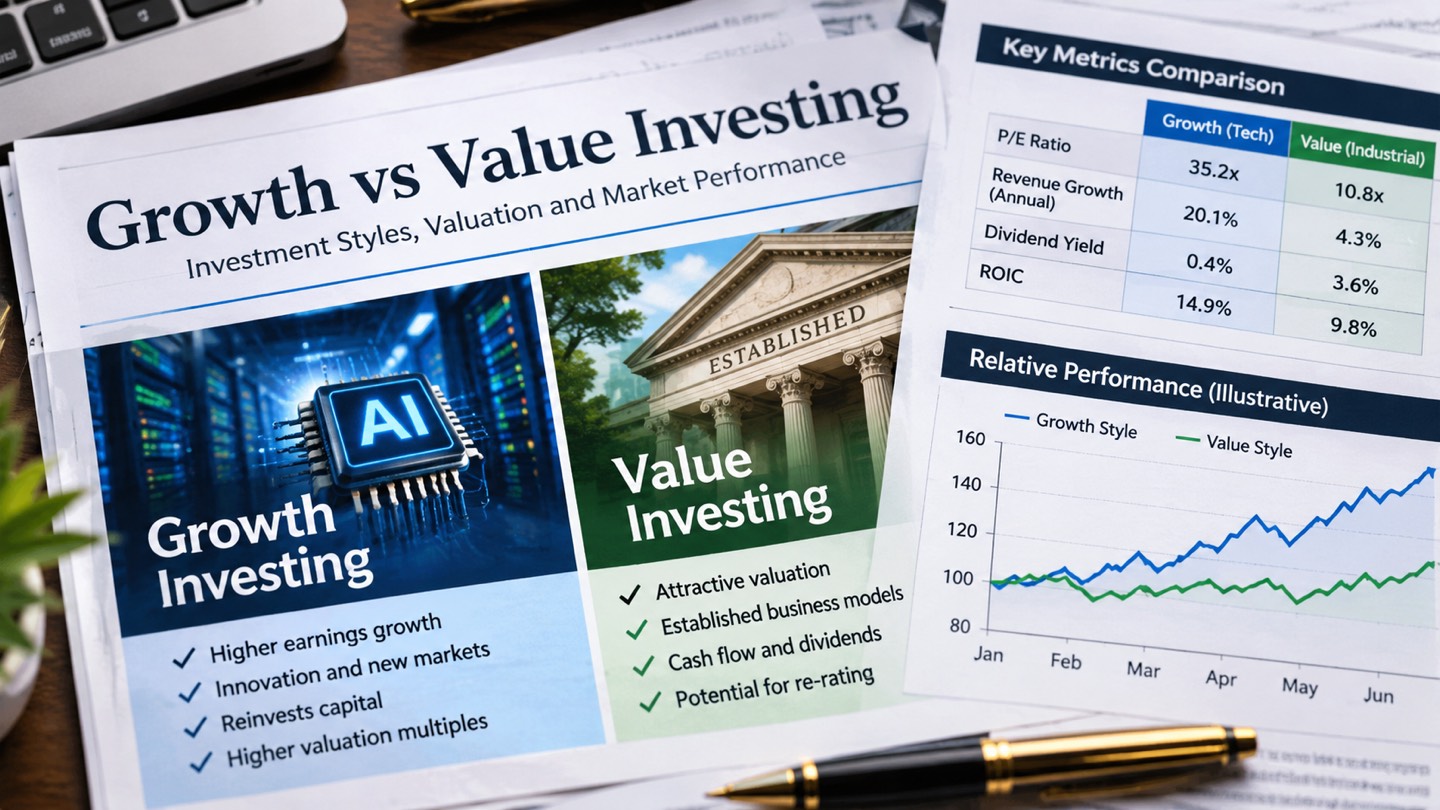
Equity investors approach financial markets with different expectations about how companies create value.
Some focus on businesses capable of expanding revenue and earnings substantially over time. Others search for companies whose market prices appear low relative to their underlying financial characteristics.
These approaches are commonly described as growth investing and value investing.
Although the distinction appears straightforward, the relationship between business growth, investment valuation and future returns is considerably more complex.
An excellent company can become an unattractive investment when its share price already reflects exceptionally optimistic expectations.
Similarly, a statistically inexpensive company can remain inexpensive for legitimate economic reasons.
Understanding both investment styles requires examining the relationship between business performance and the price investors pay for that performance.
Historical research edition: June 4, 2026. Prepared retrospectively. All company valuations and financial examples are hypothetical.
Key Research Insight
Growth and value investing are not opposing definitions of good and bad companies. Both approaches attempt to identify attractive relationships between current prices and future economic outcomes.
What Is Growth Investing?
Growth investing focuses on businesses expected to expand their operations, revenue, earnings or cash generation over time.
These companies may operate in emerging industries, introduce innovative products or benefit from expanding addressable markets.
Investors may be willing to pay relatively high valuation multiples when they believe future financial performance will justify those prices.
Common characteristics associated with growth companies include:
- Rapid revenue expansion.
- Significant investment in product development.
- Expanding customer bases.
- Opportunities to enter new markets.
- Reinvestment of earnings.
- Expectations of improving future profitability.
However, revenue growth alone does not establish economic value creation.
A business can increase sales while generating persistent losses or requiring substantial external financing.
The quality and sustainability of growth are therefore important considerations.
What Is Value Investing?
Value investing seeks opportunities where the market price appears attractive relative to the economic value of a business.
Value investors may examine earnings, assets, cash generation, financial strength and other fundamental characteristics.
They often investigate companies trading at comparatively modest valuation multiples.
These businesses may operate in established industries or face temporary economic challenges.
Potential value characteristics include:
- Modest valuation multiples.
- Established operating businesses.
- Positive cash generation.
- Tangible or identifiable economic assets.
- Shareholder distributions.
- Opportunities for business improvement.
However, a low valuation multiple does not automatically indicate undervaluation.
A business experiencing structural deterioration may deserve a lower market valuation.
Comparing Growth and Value
| Characteristic | Growth Investing | Value Investing |
|---|---|---|
| Primary emphasis | Future business expansion | Price relative to underlying value |
| Typical valuation | Higher expected growth multiples | Comparatively modest multiples |
| Cash distributions | Often reinvested | May be distributed |
| Major risk | Excessive expectations | Structural business deterioration |
| Financial sensitivity | Future earnings assumptions | Current profitability and financial strength |
These characteristics describe broad tendencies rather than strict definitions.
A company can exhibit both growth and value characteristics.
Investment index providers may classify securities using combinations of financial indicators rather than a single valuation measure.
Understanding the Price to Earnings Ratio
The price to earnings ratio compares a company's share price with its earnings per share.
A stock trading at $100 with annual earnings of $5 per share has a price to earnings ratio of 20.
This means investors are paying twenty times the specified annual earnings measure.
The ratio does not independently establish whether a company is expensive.
Its interpretation depends on expected growth, business risk, accounting quality and financial conditions.
Two Hypothetical Companies
Growth Company
35x P/E
Assumed annual earnings growth of 20%.
Value Company
10x P/E
Assumed annual earnings growth of 4%.
The growth company is more expensive relative to current earnings.
However, its future financial results may justify that premium.
The value company is less expensive relative to current earnings but may offer fewer opportunities for expansion.
Both investments require examination of the assumptions embedded in their prices.
How Valuation Multiples Influence Returns
Shareholder returns can differ substantially from underlying earnings growth.
Consider a hypothetical company initially earning $4 per share and trading at a valuation multiple of 30.
Its initial share price is $120.
Suppose earnings increase by 20% annually for three years.
After three years, earnings per share reach approximately $6.91.
The final investment outcome depends on the valuation multiple investors assign to those earnings.
| Ending P/E Multiple | Estimated Share Price | Price Return |
|---|---|---|
| 15 | $103.68 | −13.60% |
| 20 | $138.24 | +15.20% |
| 30 | $207.36 | +72.80% |
| 40 | $276.48 | +130.40% |
Despite identical underlying earnings growth, the investment outcomes vary substantially.
This demonstrates the importance of valuation risk.
The company can perform well operationally while its investors experience disappointing returns if the market reduces its valuation multiple.
The example excludes dividends, taxes and transaction costs.
Growth Quality and Capital Efficiency
Not all forms of growth contribute equally to shareholder value.
A company that generates additional revenue using relatively little incremental capital may have attractive economic characteristics.
A company requiring continuous large capital investments may generate weaker returns despite substantial revenue growth.
Researchers can examine several indicators.
| Indicator | Research Question |
|---|---|
| Gross margin | How profitable are sales before other operating expenses? |
| Operating margin | Does business expansion improve operating profitability? |
| Free cash flow | How much cash remains after relevant capital expenditure? |
| Return on invested capital | How efficiently does the company use capital? |
| Share count | Is growth accompanied by substantial shareholder dilution? |
| Debt | Does expansion require additional financial leverage? |
These measures should be evaluated together.
Rapid expansion financed through repeated share issuance may provide different shareholder outcomes from expansion supported by internally generated cash.
Understanding Value Traps
A value trap occurs when an apparently inexpensive investment remains unattractive because its underlying business prospects deteriorate.
Consider a company trading at $50 per share with annual earnings of $10.
Its initial P/E ratio is 5.
If annual earnings subsequently decline to $3, the same $50 share price represents a P/E ratio of approximately 16.7.
The investment was inexpensive relative to historical earnings but not necessarily relative to sustainable future earnings.
Common reasons for potential value traps include:
- Declining product demand.
- Competitive disruption.
- Excessive debt.
- Unsustainable dividend payments.
- Weak corporate governance.
- Deteriorating operating margins.
The central question is whether low expectations underestimate the company's prospects or accurately reflect significant business problems.
Interest Rates and Investment Styles
Equity valuation can be examined through the present value of expected future cash flows.
Higher discount rates reduce the present value of those cash flows, all else being equal.
Cash flows expected further in the future are generally more sensitive to discount rate changes.
This helps explain why some growth companies can experience substantial valuation changes when interest rate expectations shift.
Present Value Illustration
Suppose an investment is expected to generate a single cash payment of $100 in ten years.
| Discount Rate | Present Value |
|---|---|
| 3% | $74.41 |
| 5% | $61.39 |
| 8% | $46.32 |
| 10% | $38.55 |
The expected future payment remains unchanged.
Only the discount rate changes.
Hypothetical calculation assuming one payment after ten years.
Real companies generate multiple cash flows and face changing operating conditions.
The example isolates one valuation mechanism rather than predicting equity performance.
The Role of Economic Cycles
Growth and value stocks can perform differently across economic environments.
During periods of strong investment spending and technological adoption, certain growth companies may benefit from expanding opportunities.
During periods of recovery or changing commodity prices, established cyclical businesses may attract greater investor attention.
However, economic conditions do not produce guaranteed style rotations.
Starting valuations, earnings expectations, sector composition and market positioning influence realized returns.
A style that performed well during one economic cycle may behave differently during another.
Dividends and Share Buybacks
Established companies may return a greater proportion of their earnings through dividends or share repurchases.
Growth companies may retain earnings to finance expansion.
Neither capital allocation policy is automatically superior.
Reinvestment creates value when companies can generate attractive returns on additional capital.
Distributions can be appropriate when reinvestment opportunities are limited.
Share repurchases also require attention to the price at which shares are acquired and whether they offset or exceed ongoing shareholder dilution.
Growth and Value Through ETFs
Investors can obtain exposure to different investment styles through exchange traded funds.
Growth and value ETFs often follow indexes using multiple financial classification criteria.
However, funds with similar labels can have different underlying holdings.
Before comparing style funds, researchers should examine:
- Index construction methodology.
- Sector allocations.
- Largest individual holdings.
- Valuation characteristics.
- Expense ratios.
- Portfolio turnover.
- Overlap with existing investments.
Read our ETF investing research for more information about fund structure and ownership costs.
Combining Growth and Value
A diversified portfolio does not necessarily require choosing one investment style exclusively.
Combining exposures can reduce dependence on a particular set of economic assumptions.
Nevertheless, growth and value investments can both decline during broad equity market stress.
Style diversification is not equivalent to diversification across independent asset classes.
Our portfolio diversification research explains why shared risk factors matter more than the number of holdings.
Frequently Asked Questions
Are growth stocks always expensive?
No. Valuation depends on the relationship between price and expected future financial performance.
Are value stocks always safer?
No. Financial weakness and deteriorating business prospects can create substantial risk.
Can a company be both growth and value?
Yes. A growing company can also trade at an attractive valuation.
Do higher interest rates always hurt growth stocks?
No. Discount rate changes are one factor among earnings growth, financial conditions and market expectations.
Which investment style produces better returns?
Neither consistently outperforms across every economic environment and investment horizon.
Conclusion
Growth and value investing offer different perspectives on the relationship between business performance and market valuation.
Growth investors emphasize future expansion, while value investors emphasize the price paid relative to economic fundamentals.
Both approaches require careful examination of financial quality, competitive conditions and expectations.
Ultimately, investment outcomes depend not only on owning attractive businesses but also on the prices paid for their future economic performance.
Research Sources
Risk Disclosure
This article provides general investment education and does not recommend individual securities or investment funds. All company valuations and return calculations are hypothetical. Equity investments involve financial risk, and historical investment style performance does not guarantee future results.