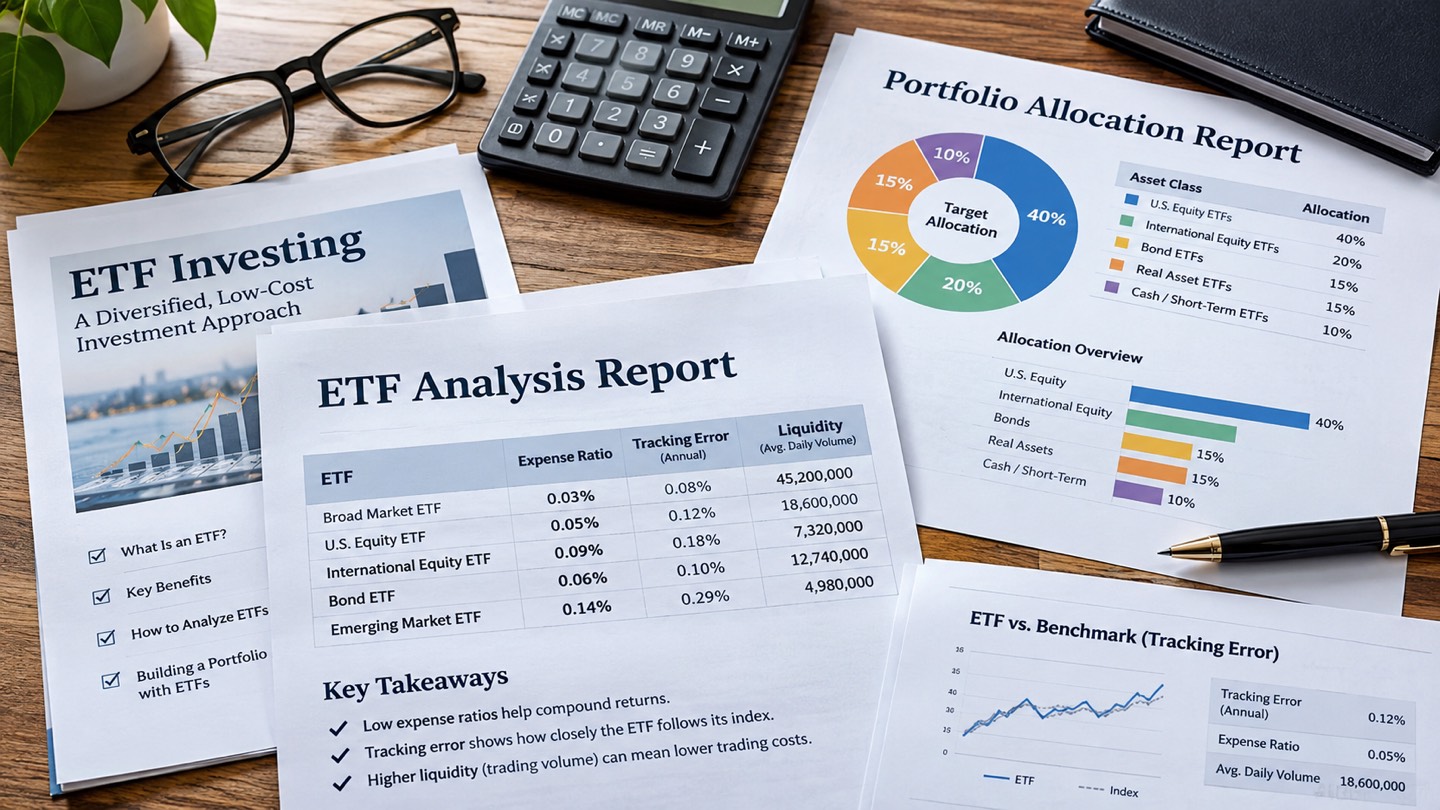
Exchange traded funds have become an important component of modern investment portfolios.
They provide convenient access to different asset classes, geographic markets, investment strategies and economic sectors.
However, two ETFs tracking apparently similar investments can produce different investor outcomes.
Management fees, portfolio construction, trading costs, taxation and tracking performance can all influence realized returns.
Understanding these characteristics is essential when comparing investment products.
Historical research edition: June 5, 2026. Retrospective educational research. All fund examples and return calculations are hypothetical.
What Is an Exchange Traded Fund?
An ETF is an investment fund whose shares can be traded on an exchange.
Depending on its investment objective, it may hold stocks, bonds, commodities or other financial instruments.
Many ETFs seek to replicate a benchmark index, while actively managed ETFs follow investment decisions made by portfolio managers.
The ETF structure should be distinguished from its underlying investment strategy.
Not every ETF provides broad diversification.
A fund concentrated in a single industry or geographic market can remain highly exposed to specific economic risks.
Understanding Net Asset Value
The net asset value, or NAV, represents the value of a fund's assets after accounting for its liabilities.
Dividing this value by the number of outstanding shares produces NAV per share.
ETF shares trade on exchanges at market determined prices.
Consequently, the trading price may differ from NAV.
| Measure | Illustrative Value |
|---|---|
| Fund NAV per share | €100.00 |
| Exchange trading price | €100.20 |
| Premium to NAV | 0.20% |
A market price below NAV represents a discount.
The size and persistence of these differences can vary according to market liquidity and the characteristics of the underlying assets.
Creation and Redemption
Many ETFs use a creation and redemption mechanism involving authorized participants.
These institutions can exchange eligible asset baskets or cash for large blocks of ETF shares, depending on the fund structure.
They can also redeem shares through the reverse process.
This mechanism can help keep the trading price reasonably aligned with the value of the underlying portfolio.
However, it does not eliminate premiums, discounts or execution costs.
During periods of financial stress, differences can become more pronounced.
What Is an Expense Ratio?
An expense ratio expresses annual fund operating expenses relative to assets.
A fund with an annual expense ratio of 0.20% incurs approximately €20 in annual expenses for every €10,000 invested, assuming a constant investment value.
The actual expense amount depends on the evolving value of the fund.
Expenses are generally reflected in fund performance rather than collected through a separate annual invoice to each investor.
The Long Term Effect of Fund Expenses
Small annual fee differences can become significant over extended investment horizons.
Consider two hypothetical funds with an initial investment of €10,000 and identical gross annual returns of 7%.
Fund A charges 0.10% annually.
Fund B charges 0.80% annually.
Using simplified net annual returns of 6.90% and 6.20%, respectively:
Rounded hypothetical values using annual compounding. Constant returns are assumed solely for illustration. Taxes, transaction costs and contributions are excluded.
Lower expenses can improve net returns when other characteristics remain identical.
However, expense ratios alone do not establish which fund is more suitable.
Tracking Difference
Tracking difference measures the difference between the return generated by a fund and the return of its benchmark over a specified period.
Consider an index that returns 10% during one year.
If an ETF returns 9.70%, its tracking difference is negative 0.30 percentage points when calculated as fund return minus benchmark return.
Tracking difference can reflect:
- Fund management expenses.
- Transaction costs.
- Portfolio sampling.
- Tax treatment.
- Cash balances.
- Securities lending income.
- Rebalancing costs.
A fund's expense ratio is therefore not necessarily identical to its tracking difference.
Tracking Error
Tracking error measures how consistently a fund follows its benchmark.
It is commonly calculated using the standard deviation of periodic return differences.
A fund may have a persistent negative tracking difference but relatively low tracking error.
Another fund may periodically outperform and underperform its benchmark, producing greater tracking error.
| Metric | Research Question |
|---|---|
| Expense ratio | What annual operating expenses does the fund report? |
| Tracking difference | How much did the fund outperform or underperform its benchmark? |
| Tracking error | How variable were those return differences? |
These metrics describe different aspects of investment performance.
Physical and Synthetic Replication
Index tracking ETFs can obtain exposure through different structures.
Physical Replication
A physically replicated fund holds underlying securities directly.
Some funds hold all benchmark constituents, while others use representative sampling.
Synthetic Replication
A synthetic fund uses financial contracts to obtain benchmark exposure.
This introduces counterparty and collateral considerations.
Neither structure should be evaluated exclusively through its label.
Investors should examine fund documentation, underlying assets, counterparties and risk management arrangements.
Understanding ETF Liquidity
ETF liquidity involves both the trading activity of the fund shares and the liquidity of the underlying portfolio.
An ETF with relatively modest exchange trading volume may still be supported by liquid underlying assets and active market makers.
Conversely, an ETF holding difficult to trade securities can experience increased execution costs during stressed conditions.
Trading volume is useful, but it does not provide a complete liquidity assessment.
Bid and Ask Spreads
The bid represents an available buying price.
The ask represents an available selling price.
The difference between them is the spread.
| Quote | Hypothetical Value |
|---|---|
| Bid | €99.90 |
| Ask | €100.10 |
| Midpoint | €100.00 |
| Spread | €0.20 |
| Relative spread | 0.20% |
An investor buying at the ask and immediately selling at the bid would lose approximately €0.20 per share before other expenses.
The spread is an important trading cost that is not included in the annual expense ratio.
For investors making frequent transactions, spreads can materially affect realized performance.
Currency Exposure
An ETF's trading currency does not necessarily determine the economic currency exposure of its underlying portfolio.
A European investor may purchase a fund priced in euros that holds US companies.
The investment can still be affected by changes in the dollar against the euro.
Currency hedged products seek to reduce certain exchange rate effects.
However, hedging may introduce costs, imperfect offsetting relationships and additional operational complexity.
Distribution and Accumulation
Some ETFs distribute investment income to shareholders.
Others retain and reinvest eligible income within the fund.
These structures can produce different cash flow characteristics and tax consequences.
An accumulating fund is not automatically more tax efficient in every jurisdiction.
Investors should consider applicable local rules, fund domicile and personal circumstances.
Evaluating ETF Concentration
An index can contain hundreds of securities while remaining concentrated in a relatively small number of companies or economic sectors.
Market capitalization weighted indexes allocate greater exposure to larger constituents.
As certain companies appreciate, their share of the index can increase.
Investors holding several ETFs may also unknowingly duplicate their exposure to the same underlying securities.
Fund holdings should therefore be evaluated collectively rather than independently.
Comparing Two Hypothetical ETFs
| Feature | Fund A | Fund B |
|---|---|---|
| Benchmark | Same index | Same index |
| Annual expense ratio | 0.10% | 0.15% |
| Typical spread | 0.15% | 0.05% |
| Replication | Physical | Physical |
| Historical tracking difference | −0.18% | −0.13% |
These hypothetical figures demonstrate why the cheapest reported expense ratio does not necessarily correspond to the lowest total ownership cost.
The appropriate comparison depends partly on investment horizon and transaction frequency.
Frequently Asked Questions
Are all ETFs diversified?
No. Some ETFs concentrate on individual industries, countries or investment strategies.
Does a lower expense ratio guarantee better returns?
No. Tracking performance, portfolio construction and other costs also matter.
Can an ETF trade above NAV?
Yes. Its exchange price can include a premium or discount.
Is ETF trading volume the only liquidity measure?
No. Underlying asset liquidity and market making activity are also relevant.
Can ETF investors lose money?
Yes. Fund values fluctuate with underlying investments and financial market conditions.
Conclusion
ETFs can provide efficient access to investment markets.
Their suitability depends on more than popularity or management fees.
Expense ratios, tracking performance, trading spreads, currency exposure and fund structure should be evaluated together.
Understanding these characteristics helps investors distinguish convenient investment access from genuinely appropriate portfolio construction.
Research Sources
Risk Disclosure
This article is educational and does not recommend any specific investment product. ETF investments involve market, liquidity, currency and other risks. Hypothetical returns are not forecasts or guarantees.